European companies 'protected' from USA sanctions following Iran nuclear row
- by Kim Reid
- in Global Media
- — Aug 7, 2018
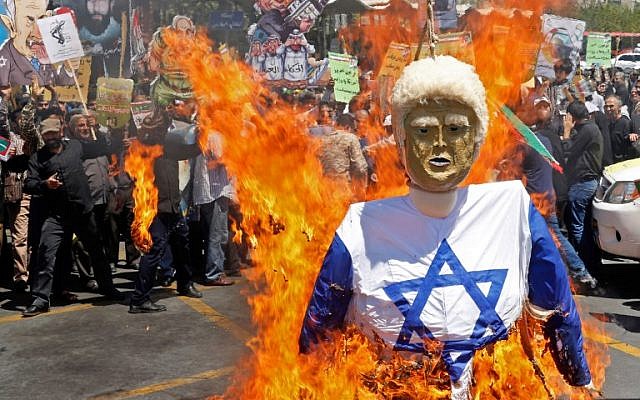
U.S. President Donald Trump holds a Make America Great Again rally in Olentangy Orange High School in Lewis Center, OH, U.S., August 4, 2018. The sanctions follow the Trump administration's withdrawal from the 2015 deal known as the Joint Comprehensive Plan of Action (JCPOA).
The European countries have promised to try to mitigate the impact of renewed USA sanctions to persuade Tehran to continue to abide by the deal's terms.
The European Union has sought to salvage the nuclear deal and provide legal cover for its companies to continue operating in Iran.
The EU said it is simultaneously implementing a "blocking statute" as the new sanctions take effect, stopping European companies from complying with the USA sanctions unless they have permission to do so. Anyone doing business with Iran will NOT be doing business with the United States. "I am asking for WORLD PEACE, nothing less", he added. Trump tweeted on Tuesday.
Administration officials told The Associated Press that the renewed sanctions were not an attempt to topple the Iranian government.
"If the ayatollahs want to get out from under the squeeze, they should come and sit down".
"The Iranian regime faces a choice", Mr. Trump said in a statement.
He also praised the "most biting sanctions ever imposed" and said they would "ratchet up to another level" in November.
He said Iran had "always welcomed negotiations" but that Washington would first have to demonstrate it can be trusted.
As sanctions bite, where next for Trump's Iran strategy?
REUTERS/Morteza Nikoubazl An anti-U.S. mural is seen on a wall of a government building in central Tehran October 12, 2011. The agency reported all protests had taken place without official permission and were subsequently broken up by police.
The newly reimposed sanctions target transactions with USA dollar banknotes; trade in gold and precious metals; direct or indirect sales of graphite and metals such as steel and aluminum; certain transactions related to the Iranian rial; certain transactions related to issuing Iranian sovereign debt; and Iran's automotive sector.
He said that the sanctions will be "fully enforced" in an "aggressive manner", including countries and companies dealing with Iran.
Iran´s Foreign Minister Mohammad Javad Zarif told reporters the global reaction to Trump´s move showed that the U.S. was diplomatically "isolated", but acknowledged the sanctions "may cause some disruption". "But talks need honesty". "Our stated policy is not to bring about regime change but to change behavior of the regime", said one of the officials.
"Preserving the nuclear deal with Iran is a matter of respecting global agreements and a matter of worldwide security".
European countries fear that by abandoning the deal, Washington risks undermining Rouhani and strengthening the hand of his more hardline opponents, who have long argued that the West would never allow Iran to prosper.
Trump announced in May that he was pulling the USA out of the 2015 nuclear deal, a key foreign policy legacy of his predecessor Barack Obama, which saw some economic sanctions against Iran lifted in exchange for limits on the country's nuclear programme.
It committed the European powerhouses to maintaining financial channels with Iran, as well as preserving the imports of oil and gas from the country.
The 2015 agreement called for Iran to sharply curb its uranium enrichment program and other nuclear activity in exchange for the end of most sanctions.